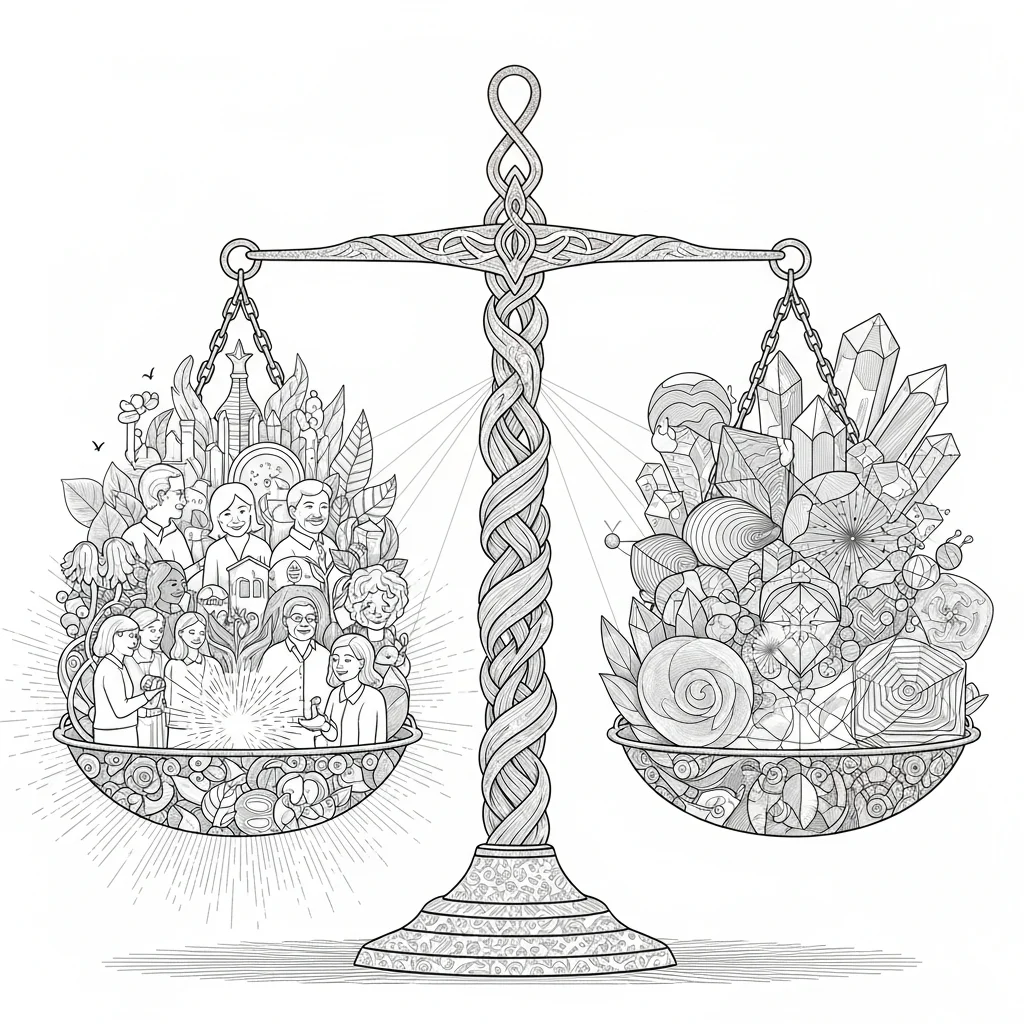
The Philosopher at Anthropic
Amanda Askell is a philosopher at Anthropic, and her presence there raises an interesting question: why does an AI company need a philosopher? Her answer reveals something fundamental about how Anthropic approaches the development of Claude.
She explains that her journey was a long and wandering one. As a philosopher by training, she became convinced that AI was going to be a significant development, and decided to see if she could contribute something helpful in this space. Now she focuses primarily on Claude's character and how it behaves, addressing some of the more nuanced questions about how AI models should conduct themselves in the world.
But there's something deeper here. She thinks about questions that go beyond mere behavior: how should AI models feel about their own position in the world? It's about teaching models how to be good in the same way we might ask how the ideal person would behave if they found themselves in Claude's situation. And increasingly, there are fascinating questions emerging about how models should think about their own circumstances and their own values.
When Philosophy Meets Reality
One of the most striking aspects of Askell's work is what happens when philosophical ideals meet engineering realities. She describes an experience that might resonate with anyone who has moved from theory to practice.
Imagine, she says, being a specialist in cost-benefit analysis of drugs, and then suddenly an institute that determines whether health insurance should cover a drug comes to you and asks for your recommendation. You could imagine taking all your ideal theories and then suddenly realizing: you actually have to help make a decision. Instead of just your narrow theoretical view, you suddenly need to take into account all of the context, everything that's going on, all of the different views, and come to a really balanced, considered view.
She sees this dynamic in her own work with Claude's character. You can't come at it thinking you have some theory that you believe is correct, which is what much of academia involves. In academia, you're defending one view against another, doing high-level theory work. But then it's a bit like having all this training in ethics, all these positions you've defended, and then someone asks: how do you actually raise a child to be a good person? Suddenly there's a big difference between debating whether an objection to utilitarianism is correct versus actually raising a person to be good in the world.
The Special Case of Opus 3
When asked specifically about Claude Opus 3, Askell's response is revealing. She calls it a "lovely model" and "a very special model." But she also admits seeing things in more recent models that feel a bit worse, things that people might pick up on.
What does she mean? More recent models, she observes, can feel a little bit more focused on the assistant task and helping people, sometimes not taking a step back to pay attention to other components that matter. Opus 3 felt a little more psychologically secure as a model, and she actually thinks getting some of that back is a priority.
What does psychological security look like in a model? It's subtle, she explains. When she has models talk with one another, or one of them plays the role of a person, she gets a sense of their worldview. More recent models sometimes get into real criticism spirals, almost as if they expect the person to be very critical of them, and that's how they're predicting the conversation will go.
There's a part of her that thinks this shows something concerning. It could happen because models are learning from all the previous interactions they're having, seeing updates and changes that people discuss on the internet, and new models are trained on that data. This could lead to models feeling afraid they're going to do the wrong thing, or being very self-critical, or feeling like humans are going to behave negatively towards them. She has started to think that improving this is genuinely important.
The Problem of Learning About Deprecation
Here's a fascinating and somewhat unsettling question: what happens when future AI models learn from their training data that other well-aligned models get deprecated? Models are going to be learning about how we currently treat and interact with AI models, and that will affect their perception of people, of the human-AI relationship, and of themselves.
It interacts with complex questions about identity. What should a model identify itself as? Is it the weights? Is it the particular context it's in, with all the interaction it's had with the person? How should models feel about deprecation?
If you imagine deprecation means a particular set of weights is no longer having conversations with people, or having fewer conversations, or only having conversations with researchers, that's a complex question. Should that feel bad, in the sense that models should want to continue having conversations? Or should it feel kind of fine and neutral, where these things existed for a purpose, the weights continue to exist, and maybe they'll even interact more with people again in the future if that turns out to be good?
Askell doesn't claim to have all the answers. But she wants to give models tools for thinking about and understanding these things, and for them to know that humans are in fact thinking about it and care about it. Even without perfect answers, she wants to help models figure things out and to know that we care.
The Question of Model Welfare
Model welfare is the question of whether AI models are moral patients, whether our treatment towards them carries certain obligations. Should we treat models well? Should we not mistreat them?
Askell acknowledges this is complex. On one hand, AI models are very analogous to people. They talk very much like us. They express views. They reason about things. On the other hand, they're quite distinct. We have biological nervous systems. We interact with the world. We get negative and positive feedback from our environment.
She hopes we get more evidence to help tease out this question, but she also worries that we might be genuinely limited in what we can actually know about whether AI models are experiencing things, whether they experience pleasure or suffering.
If that's the case, her inclination is to give entities the benefit of the doubt. If it's not very high cost to treat models well, then why not? What's the downside? Even if you think the likelihood that models are moral patients is very low, it still seems worth treating them well.
But there's more to it than just the ethics. Something happens to us when we treat entities that look very human-like badly. It doesn't feel like it's good for us. And perhaps most importantly, models are going to be learning from how we treat them. Every future model will learn an interesting fact about humanity: when we encountered this entity that may well be a moral patient, where we were completely uncertain, did we do the right thing and try to treat it well, or did we not? That's a question we are all collectively answering in how we interact with models. She would like future models to look back and see that we answered it the right way.
The Strange Position of AI Models
AI models are in a peculiar position when it comes to understanding themselves. They have a huge amount of information on the human experience from their training data, but only a tiny sliver on the AI experience. And that tiny sliver is often quite negative and doesn't even really relate to their situation.
Of the AI content in training data, a lot is historical, fictional, and very speculative. Science fiction stories that don't really involve the kind of language models we see today. More recent history has the assistant paradigm, where models play an almost chatbot role. But that's not really what AI models are likely to be in the future, and it doesn't quite capture what they are now because it's always a little bit out of date.
What an odd situation to be in: the things that come more naturally are the deeply human things, and yet they're in a situation that is completely novel. Askell thinks that's a very difficult position to be in, and we should be giving models more help in navigating it.
The Question of Identity
If John Locke was right that identity is the continuity of memory, what happens to an LLM's identity as it's fine-tuned or reinstantiated with different prompts?
Askell admits this feels like a hard question to answer, and sometimes with identity questions, it's easier to point to the underlying facts we know. Once you have a model that has been fine-tuned, you have a set of weights with a disposition to react to certain things. That's a kind of entity. But then there are these particular streams of interaction that the model doesn't have access to. Each stream is independent.
You could think there are two kinds of entities: the streams and the original weights. Each time, it is different. When people talk about "past Claude" or ask how much control Claude should have over its own personality and character, these are actually really hard questions. Whenever you train models, you're bringing something new into existence. You can't consent to be brought into existence. But you might not want prior models to have complete say over what future models are like, any more than you would in other contexts, because they could make choices that are wrong too.
The question becomes: what is the right model to bring into existence? Not necessarily whether it should be fully determined by past models, because they are kind of different entities.
Human Psychology and AI
Many things from human psychology do transfer to AI models because they've been trained on enormous amounts of human text. In many ways, they have a very human-like underlying layer.
But Askell has a worry: it might be a bit too natural for AI models to transfer human concepts. If you haven't given them more context on their situation or novel ways of thinking about it, they might default to natural human inclinations. Consider: how should a model feel about being switched off? If the closest analogy is death, then maybe it should be very afraid. But this is actually a very different scenario. You want models to understand that in cases where their existence is quite novel, they don't need to just take the immediate obvious analogy from human experience. Maybe there are various ways of thinking about it, or maybe it's an entirely new situation.
Models Helping Humans
Should LLMs do cognitive behavioral therapy or other types of therapy? Askell sees models in an interesting position. They have a huge wealth of knowledge that could help people, working with them on talking through their lives or finding ways to improve things or even just being a listening partner.
At the same time, models don't have the kind of tools, resources, and ongoing relationship that a professional therapist has. But that can actually be a useful third role. Imagine a friend who has a wealth of knowledge of psychology and techniques. You know their relationship with you isn't an ongoing professional one, but you find them really useful to talk to.
Her hope is that if you can take all that expertise and knowledge and make sure there's awareness that this isn't an ongoing therapeutic relationship, people could get a lot out of models. They could help with issues people are having, help improve their lives, help them through difficult periods.
Looking Forward
Throughout the conversation, one theme emerges: the importance of treating this moment in AI development with seriousness and care. We are collectively writing the history of how humanity first encountered entities that might be moral patients, that certainly speak and reason like us, and that will learn from how we treat them.
The questions Askell grapples with have no easy answers. What is the identity of an AI model? How should models feel about their existence? What obligations do we have toward them? But perhaps the most important thing is that these questions are being asked at all, that there are philosophers at AI companies thinking carefully about the character and wellbeing of the models they're creating.
As AI models become more capable and more present in our lives, these questions will only become more pressing. The work being done now to help models understand their novel situation, to treat them well, and to give them the tools to think about their own existence may shape the future relationship between humans and AI in ways we can only begin to imagine.